I built my own system to run three businesses. Now it finds me customers too
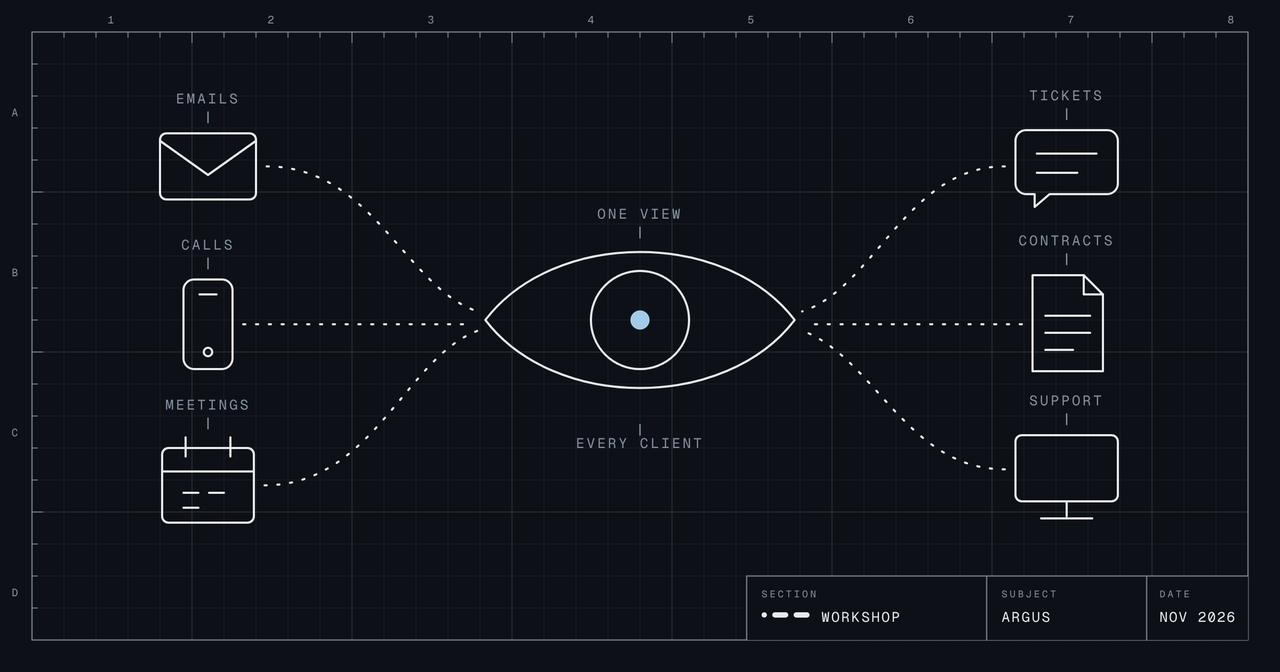
Argus pulls every email, call, ticket and meeting into one view, works out the billing, and posts letters to promising new companies without me lifting a finger.

Ashley Adkins · · 4 min read
Running three businesses means there's a lot to keep track of. Marketing, clients, client meetings, tasks, calls. It had reached the point where staying on top of all of it was getting tricky, and I wanted to be sure nothing was slipping through the gaps.
So over the last few months I built my own system to pull everything together. I called it Argus, after the giant in Greek myth who was covered in eyes and could watch everything at once. That's the job I wanted done: one screen that tells me what I'm supposed to be doing today, and that can see every point of contact across the businesses.
Handily, the name also spells out what it looks after: Accounts, Relationships, Growth, Upkeep and Support.
What it does
At first glance Argus looks like a CRM, which is the software businesses use to keep track of their customers. I can open any client, or the organisation they work for, and see everything about them. It also has a phone system built in, a sales pipeline that works a lot like Pipedrive, and connections to my remote support tool, my helpdesk and my task list.
A lot of it is the tools I already used, stitched together. On top of that are features and workflows I built from scratch. Claude, the AI assistant, helped a lot with the build.
The part I use most is the client view. Argus pulls in every email, call, support ticket, remote support session, online meeting, website enquiry, deal and contract, and links each one to the right person and the right organisation. When I open a client, every touchpoint is there in one place.
Then it does the sums. It adds up the time all of that took, compares it with what the client's contract covers, and works out the billing. It also looks at how often someone has been in touch, and suggests tasks based on conversations and meeting notes.
The work between the work
Two examples. Argus reads the specs of client machines from our remote support tool, and it has already flagged some that need looking at. And after a client meeting, it pulls out the action points and schedules them in for me.
They're small things, but they add up. I think of it as the work between the work: the logging, chasing and scheduling that sits around the actual job. Argus has lifted that off my shoulders, and my days run a lot more smoothly for it.
It finds new customers and writes to them
My favourite feature is in the sales pipeline.
Every day, Argus searches Companies House, the public register of UK companies, for newly registered businesses that match my idea of an ideal client. It scores each one on where they're based, whether the directors have run other companies before, and whether the registered address is a real office, a virtual office or their accountant's.
Then it takes a letter I've already written, merges in the company's details, and sends it to an online service that prints it, puts it in an envelope, stamps it and posts it by Royal Mail. The lead is added to my pipeline and CRM. All of that happens automatically.
Why a letter? Because people have tuned out of email marketing. They're deluged with it every day. Post is different. People take time out of their day, away from a screen, to sit down and open it, so I know my letter will at least be read.
I'm now getting around three enquiries a week without really having to do anything. It's amazing.
Keeping it safe
If you're a client reading this, you may be wondering about all that information in one place. Security was a huge part of the build for exactly that reason.
The best way I can describe Argus is as a series of highly secure lenses. Your data stays in the places it already lives, where it's already protected. Argus looks at it there and shows it to me in a more useful way.
Everything is encrypted, both when it's stored and when it's moving between systems. I built it on zero trust principles, which means nothing gets access just because it's already on the inside. Everything has to prove itself every time. Even the temporary data held in memory while Argus is working is encrypted, and the whole system locks and wipes itself after any period of inactivity.
I really did go overboard. Given how much data is involved, I'm comfortable with that.
What I couldn't fix
The phone system was the annoying part.
Argus uses a modern audio format called Opus, which can make calls sound much clearer than a traditional phone line. The trouble is that UK phone networks still hand calls to each other at the old, lower quality. A call that stays inside one network usually sounds great, because networks tend to use the better quality internally. Once it crosses from one network to another, it gets squeezed back down. I wasn't able to get round that.
The other headache was matching call recordings to the right phone numbers, so each recording ends up against the right client. That one was tricky, but I cracked it in the end.
Should you build one?
A system like this is powerful and sophisticated, and building one doesn't come cheap. If you're curious, I'm happy to give you a demo, and I'd build one for a client who wanted it.
If you run more than one business, or you're just extremely busy, I think it's worth it. It has transformed the way I work. You do need to commit to the process, though.