"Nobody would bother hacking us" is the most expensive thing a business owner can say
Small businesses tell me they're too small to be worth hacking. Then a laptop in a cupboard takes down a restaurant, and a fake invoice costs a record label £100,000.

Ashley Adkins · · 5 min read
I hear it at least once a month, usually from someone perfectly sensible: "We're only small. Nobody would bother hacking us."
I understand why people think it. When you picture a hacker, you probably picture someone choosing a target. A bank, a government department, a big name with something worth stealing. A 15-person firm in the Midlands doesn't feel like it's on anyone's list.
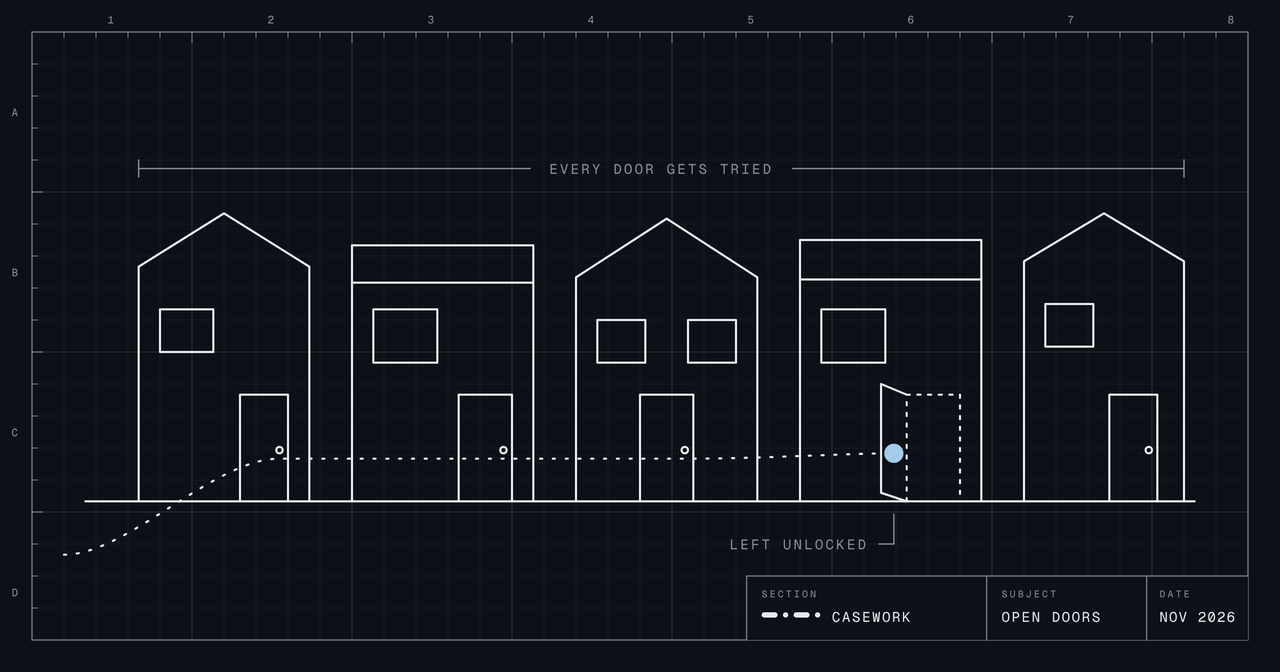
It isn't. That's the problem. Nobody is choosing you. They're trying every door on the street, and yours is the one that's open.
Nobody picks you. You just turn up.
Most attacks on small businesses aren't planned in a dark room. They're automated. Software scans the internet all day looking for the same handful of mistakes: old equipment that hasn't been updated, remote access left open, passwords that have already leaked somewhere else. When it finds one, it doesn't care whether you're a bank or a bakery.
And it's getting cheaper. AI tools have made it far easier to write convincing scam emails, copy someone's writing style, and run attacks at a scale that used to need a team of people. The cost of having a go has dropped close to nothing, so they have a go at everyone.
Meanwhile, the bigger companies have spent years tightening up. Small firms mostly haven't, because they've stuck with the idea that they don't matter. So they've become the easy option.
I'm seeing the result. Lately there's been a real rise in businesses getting in touch with me after something has already gone wrong. Here are three of them, with the details changed so nobody can be identified.
The laptop that played the music
A busy restaurant and members' club in central London called me because their files had started scrambling. The membership list, the ordering sheets, staff timesheets, menu designs. All of it, on every computer and phone that used their shared Dropbox.
None of their everyday computers turned out to be the source. It was an old laptop in a cupboard whose only job was playing music through the building's speakers on a loop. Nobody had thought of it as a computer for years. It hadn't been updated in a long time, and at some point someone had signed in to Dropbox on it.
That was enough. Ransomware got onto the laptop, and Dropbox did exactly what it's designed to do: it copied the changes everywhere, faithfully, in seconds.
They were lucky. A few machines hadn't been switched on that day, so they still had clean copies from the night before. We had them running again the same day with nothing lost. But it's worth saying plainly: a file that syncs to the cloud is not a backup. It copies damage just as happily as it copies good work.
Caught in the act
A large online retailer had left remote access to their office server open to the internet, and their server and router hadn't been updated. When I connected to the server to start work, the attackers were still connected and their software was still encrypting files.
We shut them out and stopped it before it finished. No ransom was paid and no data was lost for good. But the website was down for at least a week, full recovery took a couple of weeks, and the lawyers and insurers got involved. Thousands of product photos had to be renamed and reformatted by hand just to get the shop back online.
The part that still bothers me is this: their backups were connected to the same server the attackers were sitting on. Given a bit more time, they could have deleted or encrypted the backups too. That's the difference between a bad fortnight and losing the business.
An invoice from the boss. Except it wasn't.
This one is the quietest, and the most expensive.
A record label with about 15 staff had their CEO's email account broken into. Nobody noticed. The attackers downloaded the whole mailbox and then simply read it, for months. They learned how the CEO wrote, who the label paid, and which invoices were due.
Then they waited until the CEO was away. The finance administrator got an email from the CEO's real account, written in the CEO's usual style, about an invoice they were genuinely expecting. The only thing that had changed was the bank details. It needed paying today.
They paid it. About £100,000. Nobody knew until the real supplier rang to ask where their money was. None of it came back.
Changing the password afterwards wasn't enough on its own, either. The attackers had quietly set up rules on the mailboxes they'd reached to forward copies of emails to themselves, and those would have carried on working in the background.
The fix that would have saved them the £100,000 cost nothing at all: a phone call to the supplier, on a number they already had, before paying new bank details.
None of them were interesting
Look at those three again. A music laptop. A door left open for remote access. A mailbox nobody was watching. Not one of them was hit because of who they were. They were hit because they were easy.
The other thing they had in common is that nobody had ever thought about what the first hour after an attack would look like. Who do you call? Can you still trade? Who do you have to tell, and by when? What happens to your customers, your suppliers, your staff's wages? What will it cost?
Most business owners I meet haven't asked themselves any of that. I don't think it's because they can't. I think it's a blind spot they're wilfully ignoring, because "nobody would bother" is a much more comfortable thing to believe.
If you do one thing this week
Apply for Cyber Essentials.
It's the government-backed scheme that covers the basics: keeping things updated, controlling who can get in, using proper passwords and two-step sign-in, protecting against malware, and setting up your firewall and equipment sensibly. Every one of the three stories above would have been stopped, or made much smaller, by those basics.
The certificate is useful, but the real value is in getting there. By the time you've worked through it, you'll have covered the things that actually keep you secure, rather than just hoping.
It's also cheaper than it's ever been. The government's Cyber Essentials First Step Fund takes 75% off the cost of your first certificate, which brings it down to somewhere between £80 and £125 plus VAT. It's open to micro, small and medium-sized businesses that haven't held Cyber Essentials in the last four years, and it runs until March 2027 or until the money runs out, whichever comes first. You can apply at firststep.iasme.co.uk.
That's less than most businesses spend on coffee in a month. The record label would tell you it's a bargain.