AI has made the old tricks cheap enough to use on everyone
The NCSC says AI attacks are exploiting nothing new. I agree. What has changed is that the research once saved for the boss is now done on the new starter.

Ashley Adkins · · 4 min read
This week the National Cyber Security Centre said something I've been telling clients all year. Since September it has seen "a marked rise in AI-assisted cyber attacks", with organisations in several sectors reporting incidents. It also said that "none of the weaknesses being exploited are new or novel."
Criminals are getting in the same old ways, only far faster and for next to nothing. That matches what I see every week.
What the NCSC said
The warning is about software that was built for security testers. Someone points it at a company, and an AI model works through everything that company has connected to the internet, looking for mistakes: passwords left on their factory setting, logins saved in the wrong place, old systems nobody remembered were still switched on. It tries everything it finds, learns from each failure and, in the NCSC's words, "moves from discovery to exploitation in minutes".
What gets caught out, it says, are "unmitigated weaknesses that are often the result of years of technical debt". Technical debt is the polite name for all the jobs that got put off. The old server nobody wanted to touch. The account set up in a hurry and never tidied.
The NCSC's annual review, published at the start of November, makes the wider point. AI is "unlikely to fundamentally change the goals of hostile actors", but it is "highly likely to increase the speed, scale and efficiency with which they operate." It then lists the parts of an attack that AI is already improving. Two of them are reconnaissance and social engineering, which in everyday terms means researching people and then tricking them.
Those two are where I've noticed the change most.
What it looks like from where I sit
Across my clients, attacks are up. Nothing about them is especially new or exciting. There's simply more of everything: more phishing, more polish, and far more messages written for one particular person.
The personal targeting is the new bit. Researching a target used to cost a criminal real time. Reading someone's LinkedIn profile, working out who their colleagues are, what they're interested in, what they posted last week. That effort was kept for people who could move serious money. Nobody would have bothered doing it for an ordinary member of staff at a small firm.
Now software does it in seconds, for free. So everybody gets the new hyper-tailored version.
The new starter
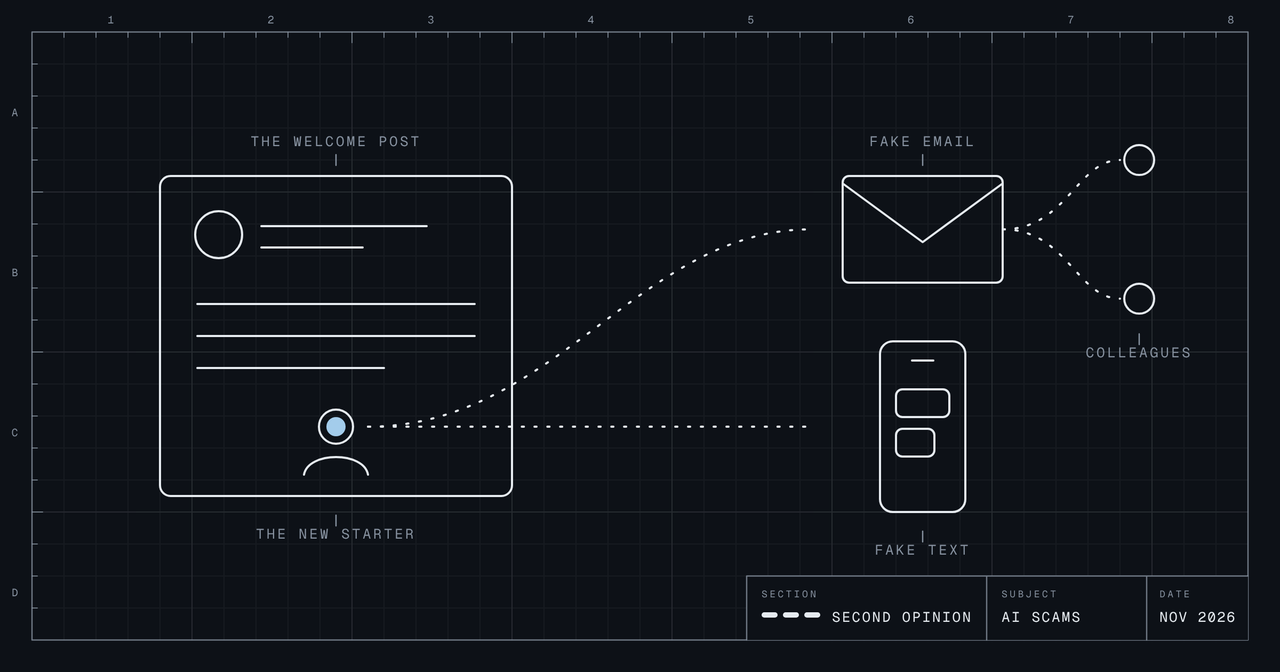
A new starter joined one of my clients. Within their first week, emails began arriving that claimed to be from the chief executive, and they piled on the pressure.
Put yourself in their shoes. They don't yet know who's who. They don't know how the company does things, or whether the boss really does email people out of the blue. They want to make a good first impression. Ignoring the chief executive in week one takes some nerve.
To their credit, they ignored the emails and blocked the senders. That went on for a week. Then the messages started turning up as iMessages on their own phone.
When I looked into it, the trail was short. Their phone number and email address were on their personal LinkedIn profile. And the company had tagged them in a "Welcome to the team" post on its own page. It was a friendly post, the kind every business puts up. It also told anyone looking that here was somebody brand new, keen to impress and not yet sure how things worked, with a link straight to their contact details.
The risk to the business is obvious. I felt for the new starter more than anything. Starting a new job is stressful enough. Being chased by someone pretending to be your boss, on your personal phone, before you've learnt where the kettle is, must have been miserable. And the criminals picked them for exactly that reason. New people are under pressure and want to do well.
What I changed
I did three things.
- I told everyone.
I ran awareness training for the whole team, explained what had been going on and showed them what to look out for. - I tightened the email system.
The domains the messages came from were blocked, and we added rules to catch email pretending to come from inside the company. - I changed how the company welcomes people.
New starters are no longer tagged in posts, and the company uses first names only online.
The third one I'd suggest to any business (even though it seems obvious when you say it out loud). You can still welcome people in public. Just don't hand strangers a link to their profile on day one.
The trick no filter can catch
The technical fixes help, but they have a limit, and the criminals have found it.
They used to fake the company's email address, or register a web address one letter away from the real one. Both can be spotted and blocked. So many of them have stopped bothering. They open a free Gmail account, set the name on it to your chief executive's name, and press send.
There is nothing for a filter to catch, because nothing is technically wrong. Choosing the name that appears on your emails is how email has always worked. If your mail app shows the name and tucks the address away, the message looks like it came from the boss.
So the only thing left is a person noticing that the address behind the name is wrong, and that person has usually only just joined.
This is why I think awareness training matters so much. It's also why I set up Lessons fromIT, a free cyber security awareness course with a certificate at the end.
So is the NCSC right?
Yes, and I find its conclusion oddly reassuring. AI, it says, "does not make established cyber security controls obsolete. In fact building strong foundations has never mattered more." It adds that nearly everything it has seen could have been prevented by good practice that already exists.
If these attacks were new, we'd all need new defences. They are the old attacks at a much bigger scale, so the old defences still work. Keep your systems updated. Turn on two-step sign-in. Know what you've got connected to the internet. And make sure your people know what a fake looks like, because some fakes will always get through.
Criminals no longer have to decide who is worth the effort. It's everyone now, the new starter included.